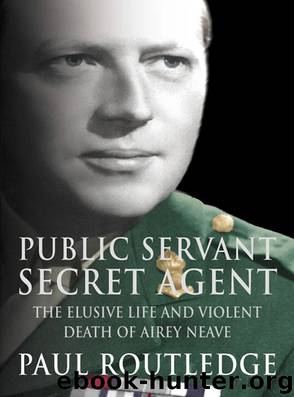
Public Servant, Secret Agent by Paul Routledge
Author:Paul Routledge [Routledge, Paul]
Language: eng
Format: epub, azw3
Publisher: HarperCollins Publishers
Published: 2002-09-17T04:00:00+00:00
12
The Greasy Pole
The summer of 1953 was an opportune moment for a young Conservative to enter Parliament. The Queen had just ascended the throne and a New Elizabethan age was promised. Her coronation in Westminster Abbey, watched on new-fangled television by millions of her subjects, was crowned by the news that a Commonwealth expedition had conquered Everest. It was a good time to be a patriot. The economy was doing well and Britain was struggling to find a new, independent path for her colonies, particularly in Africa.
In one of his first speeches to the Commons as peacetime Prime Minister, Churchill called for a lull in party strife and several years of quiet, steady administration ‘if only to allow socialist legislation to reach its full fruition’, a statement hardly likely to endear his strategy to Neave. However, the Labour Party was exhausted, drained by years of rule during post-war austerity and infighting thereafter. It opposed Conservative cuts in food subsidies, but in the face of compensating increases in pensions, benefits and family allowances made little political headway. The second Budget from the Chancellor, R.A. Butler, in 1953, cut income tax by 6d in the pound, increasing the Conservatives’ popularity to the point where they were able to take Sunderland South from Labour, the first time a government had won a seat from the Opposition at a by-election for almost thirty years.
After his maiden speech, Neave did not seek to make much of a splash on the back benches. Instead, he continued to mark out his chosen territory: defence and related issues. He was on his feet in a debate on the Navy, Army and Air Force Bill later that year, speaking up for his favourite unit, the Territorials. On 17 November, he raised a number of arcane points about the Bill’s distinction between Territorials and reservists, and to urge the army to keep track of the jobs now being done by men who faced the call-up. He had an argument with the prickly Labour MP for Brixton, Lieutenant-Colonel Marcus Lipton, about the exact date of the ‘embodiment’ of the TA in 1939, and sat down. It was not a brilliant exercise, though it did mark out his political interests and he followed up the intervention with a written question in February 1954 about training for the ‘Terriers’. The following month, he began a long parliamentary involvement with the atomic energy industry and its professionals. In the second reading of the Atomic Energy Bill, Neave observed: ‘We have reached a stage in the history of atomic power at which we can take stock of the achievements of our scientists.’ He praised the ‘mental stimulus’ of his own constituents employed at the Atomic Energy Research Establishment at Harwell: here (though Neave did not say it) they not only sought peaceful ways to harness the power of the atom but also built Britain’s atomic bomb. Neave commended the ‘not very sensational or revolutionary Bill’, but urged that more homes be built for the staff
Download
Public Servant, Secret Agent by Paul Routledge.azw3
This site does not store any files on its server. We only index and link to content provided by other sites. Please contact the content providers to delete copyright contents if any and email us, we'll remove relevant links or contents immediately.
Waking Up in Heaven: A True Story of Brokenness, Heaven, and Life Again by McVea Crystal & Tresniowski Alex(37768)
Empire of the Sikhs by Patwant Singh(23059)
We're Going to Need More Wine by Gabrielle Union(19020)
Hans Sturm: A Soldier's Odyssey on the Eastern Front by Gordon Williamson(18555)
Leonardo da Vinci by Walter Isaacson(13292)
The Radium Girls by Kate Moore(12003)
Tools of Titans by Timothy Ferriss(8347)
Educated by Tara Westover(8033)
How to Be a Bawse: A Guide to Conquering Life by Lilly Singh(7458)
Permanent Record by Edward Snowden(5812)
The Last Black Unicorn by Tiffany Haddish(5617)
The Rise and Fall of Senator Joe McCarthy by James Cross Giblin(5259)
Promise Me, Dad by Joe Biden(5130)
The Wind in My Hair by Masih Alinejad(5070)
A Higher Loyalty: Truth, Lies, and Leadership by James Comey(4937)
The Crown by Robert Lacey(4791)
The Iron Duke by The Iron Duke(4337)
Joan of Arc by Mary Gordon(4080)
Stalin by Stephen Kotkin(3940)
